Janet Murray paints a vivid portrait of a sensation based storytelling medium in which human response is in relation to a simulation. She points out that technicians have programmed the correct pitch and frequency into the machine in order to produce an array of human emotions. It reminds me of binary code. It can be broken down into formulas where pitch plus frequency minus volume (0) is equal to the equivalent emotion where most humans produce tears in response to despair. (1)
The author presents this and makes the reader think about the possibilities. Could it be real time fantasy or is it debilitating like an addiction? There's also endless possibilities for education. I can think of at least 100 works of fiction that I suffered through, and imagine what sensation based storytelling could do to transform them.These possibilities might make it well worth wiring myself to the machine.
Since this medium is sensory based, the old classics of literature can breathe again. I can imagine the new option of picking which character's viewpoint you would like to see/hear/touch. Instead of the pure and predictable Pip, I could experience Great Expectations through Estella's senses. Miss Havesham's bittersweet maniacal ways would be a personal experience. This medium is probably what Huxley and Bradbury would consider most persuasive. It requires total immersion.
I was surprised to find Murray's book published in 1997. I would have guessed the publication date no earlier than the year 2000. This thought is directly followed by how much time everyone wasted on the Y2K scare. Glorianna Davenport and Brian Bradley published an article the same year, where they discuss the future of the cinema experience. They seemed to share Murray's vision of encompassing all of the senses.
Murray's description of of the "feely" theater experience contains the word horror. I can see why some people would feel threatened by this, even saddened. I can also think of another group of people who would accept this and not feel bothered by it. Sometimes the human response is engineered. It is done everyday by commercials, television, and movies. I don't think that human emotion is so complex that it could not be re produced by a command prompt or a machine. I think it could be hacked. People use emoticons in their letters as a simple way of attaching human emotion to their words. Although this is a fetal attempt at deciphering human emotion, it stems from the need to apply a formula to something overwhelming. We like to group things and reduce complex ideas to usable formats.
Thursday, March 15, 2007

Friday, March 2, 2007
Picture Theory
In O'Gorman' second chapter, he discusses picture theory and the first painting that the reader is able to see is Stephen Gibb's Eye Socket. This painting poses a question. Can a body part really be considered another outlet? Can it really be boiled down to that? Our senses are essentially that. We process information through our senses, and I think that this is O'Gorman's point in this chapter. Although the Republic of Scholars considers language as the official method of delivering information, the author introduces us to the concept of pictures, paintings, words, and symbols as vibrant ways of communicating ideas.
Language seems to operate on old paradigms, in which there is only one set of rules for learning and communicating. We have actually evolved into a culture that expects symbols to drift in and out of focus. There are symbols on public bathrooms, drive ins, and shopping malls. They inform us of the mundane as well as the need to beware. The biohazard symbol clearly communicates potential danger without a word, sentence, or punctuation.
I especially like O'Gorman's idea about painting with Salvador Dali or Max Ernst. I think its important to point out that these artist were not considered part of the art world. Their work was considered crude, childish, and downright offensive. Dali was a surrealist and often painted images from his own dreams. Ernst's work can sometimes appear like a nightmare, with random images fused with the human body. In the tradition of the cyborg, both artist took what they liked from art and put together a new creation. They built their own genre , instead of conforming to the rules.
He discusses William Blake in a later chapter but he touched on the fact that he was one of the first artist to make use of text in artwork. In researching Blake, he did appear mad at times but I think that this idea was in one of his more lucid moments. He wanted to make a bigger impact and reach a broad audience. Despite ridicule, Blake continued on this path and added text to a great many of his paintings.
O'Gorman says quite frequently that the is trying to short circuit the ideas associated with old media. The author supports new ways of conducting humanities research. New media should be able to present ideas in the same rich way that the book used to. Ideas may even become clearer once we make use of hyper links, rich colors, and graphs. The internet is so accessible that it would be a waste if it were not used. I would even like to see it used to its full capacity.
Language seems to operate on old paradigms, in which there is only one set of rules for learning and communicating. We have actually evolved into a culture that expects symbols to drift in and out of focus. There are symbols on public bathrooms, drive ins, and shopping malls. They inform us of the mundane as well as the need to beware. The biohazard symbol clearly communicates potential danger without a word, sentence, or punctuation.

I especially like O'Gorman's idea about painting with Salvador Dali or Max Ernst. I think its important to point out that these artist were not considered part of the art world. Their work was considered crude, childish, and downright offensive. Dali was a surrealist and often painted images from his own dreams. Ernst's work can sometimes appear like a nightmare, with random images fused with the human body. In the tradition of the cyborg, both artist took what they liked from art and put together a new creation. They built their own genre , instead of conforming to the rules.
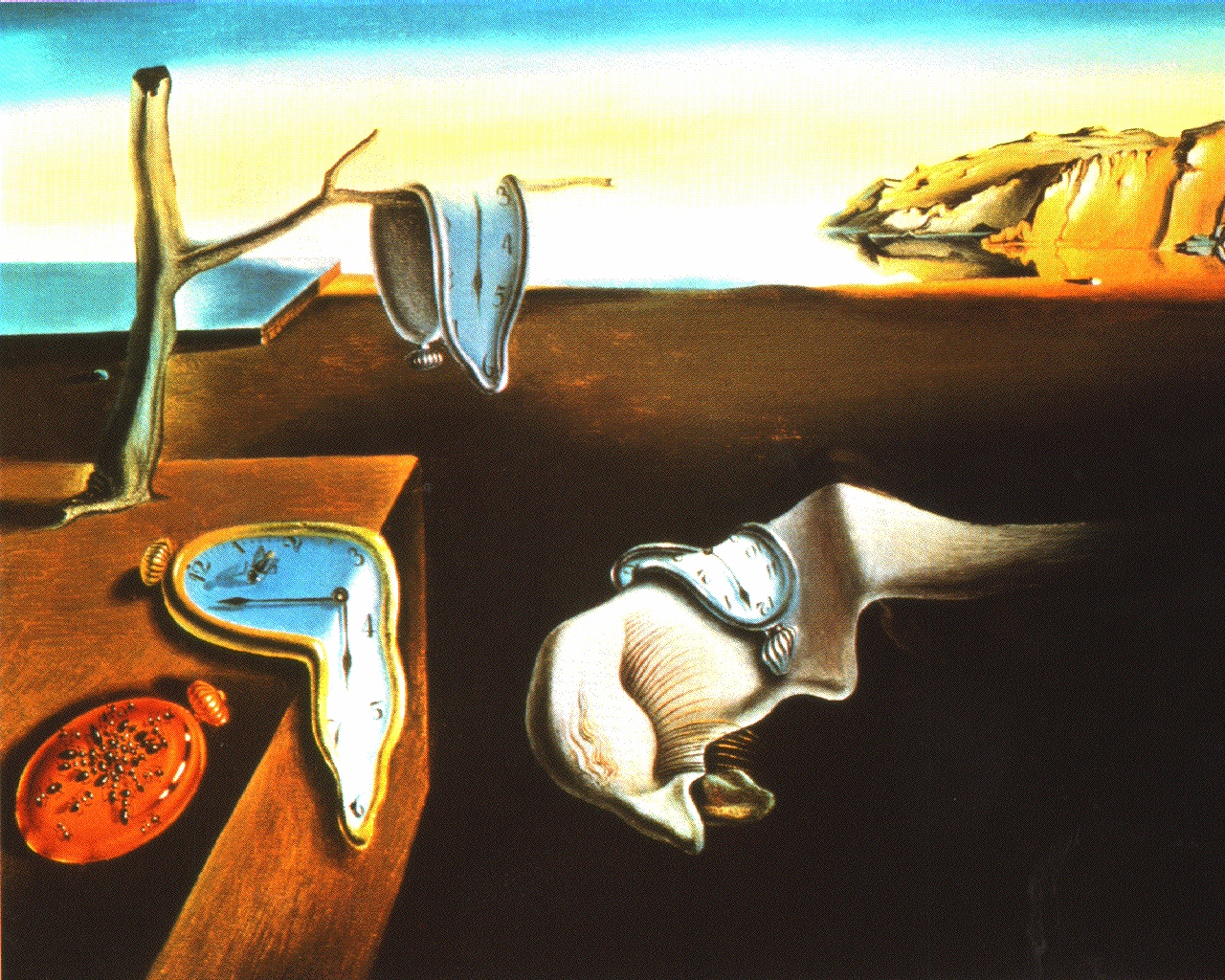

He discusses William Blake in a later chapter but he touched on the fact that he was one of the first artist to make use of text in artwork. In researching Blake, he did appear mad at times but I think that this idea was in one of his more lucid moments. He wanted to make a bigger impact and reach a broad audience. Despite ridicule, Blake continued on this path and added text to a great many of his paintings.

O'Gorman says quite frequently that the is trying to short circuit the ideas associated with old media. The author supports new ways of conducting humanities research. New media should be able to present ideas in the same rich way that the book used to. Ideas may even become clearer once we make use of hyper links, rich colors, and graphs. The internet is so accessible that it would be a waste if it were not used. I would even like to see it used to its full capacity.
Thursday, March 1, 2007
Education and Structure
The first thing I liked about Nelson was his conversation-like prose. His ideas were presented in a friendly and personable manner. His writing style is actually a good example of his ideas on education. He doesn't condescend, nor does he seem to place any additional barriers between the reader and the text. He emphasizes the need to re evaluate the system that controls education. This portion of the text was the most impressive.
Even the concept of a system of education places a leash on the desire to learn. I don't think that Nelson wants to throw the whole system away,as much as he wants to place the flaws in front of us where they can't be ignored. He makes a point that topics are presented on one angle. Old standards guide what is to be taught, even though technology has made many of these obsolete. This stifles intelligence, not to mention creativity. Learning has become rigid, and much of this is because of our institutions.
Nelson also advocates those willing to educate themselves. Too much attention is placed on the exchange between student and teacher. Some even consider the education that comes from accredited teachers as a sort of "official knowledge", while dismissing the important skills they have learned on their own. I agree with Nelson, that education consistently places a wall between the student and the information and ideas contained in a subject.
CAI seems like an idea that will take away some of the negative aspects of traditional education. A student can afford to get comfortable with the subject matter. There is no teacher racing through material at warp speed. A student's questions will never be ridiculed by CAI. Most importantly the student can breathe, and take in the material as opposed to studying the system. Students usually spend a great deal of time learning what they believe to be "the right answers" rather than the array of concepts and possibilities offered by the material.Education is at its peak when it can provoke thought. It should not be based in tests that have students memorize obscure dates that they will gladly forget in the next hour.
Even the concept of a system of education places a leash on the desire to learn. I don't think that Nelson wants to throw the whole system away,as much as he wants to place the flaws in front of us where they can't be ignored. He makes a point that topics are presented on one angle. Old standards guide what is to be taught, even though technology has made many of these obsolete. This stifles intelligence, not to mention creativity. Learning has become rigid, and much of this is because of our institutions.
Nelson also advocates those willing to educate themselves. Too much attention is placed on the exchange between student and teacher. Some even consider the education that comes from accredited teachers as a sort of "official knowledge", while dismissing the important skills they have learned on their own. I agree with Nelson, that education consistently places a wall between the student and the information and ideas contained in a subject.
CAI seems like an idea that will take away some of the negative aspects of traditional education. A student can afford to get comfortable with the subject matter. There is no teacher racing through material at warp speed. A student's questions will never be ridiculed by CAI. Most importantly the student can breathe, and take in the material as opposed to studying the system. Students usually spend a great deal of time learning what they believe to be "the right answers" rather than the array of concepts and possibilities offered by the material.Education is at its peak when it can provoke thought. It should not be based in tests that have students memorize obscure dates that they will gladly forget in the next hour.
Subscribe to:
Posts (Atom)