Sunday, April 29, 2007

Down With MLA Research IV


I've had several ideas for my senior project, but I keep returning to this one idea that seems to be lit like a neon sign. While researching the subject, the scattered pieces have started to come together to form a solid picture. It's even managed to possess a half-life, because I find myself thinking about this at the most random times. The fact that I am exited about it and willingly contemplate its possibilities, leads me to believe that it may be the right choice.

I think that for the most part academia is moving away from all the dead trees. Essays, term papers, and reports will be submitted via tools like Blogger. I've actually enjoyed Blogger's versatility and feel refreshed that I can create hyper text to transport the reader to a precise platform of information and ideas. Since tools like Blogger seem to work so well, I feel certain that it, along with similar sites, will grow in popularity and lead to wide spread use by both students and professors alike. This leads me to reconsider how our sources are cited.

I have so much respect for authors, scientist, and programmers ect. who have devoted much of their lives to that one fierce novel, stepping stone research, or the perfect program that I have become a die hard fan of giving credit where credit is due. If the medium really is the message, as Mcluhan says, then what message is being conveyed by the continued use of MLA citation? On my copy of the MLA Handbook for Writers of Research Papers, the earliest copyright date is 1977, and this is a fourth edition. This handbook was developed by the Modern Language Association of America (MLA), and has served as a bible for various writer's of reports, documents, essays, and dissertations even though it can hardly claim to be modern.

The organization was founded in 1883 and my brain is swimming with how evolved language has become since then. When I consider how efficient Blogger is at submitting my assignments, it seems highly ineffective, inefficient, and down right cheap to attach an MLA citation. It does its job, but only on the most basic level. It does not however,have the capacity to serve rich text as O'Gorman has encouraged people to make use of. The internet provides a wide spectrum of text and colors, and O'Gorman is quick to demonstrate how pictures and symbols can communicate just as well as language. Foucault's philosophy has probably helped me the most because he points a finger at language and declares it a transparent medium. No one thinks about it anymore and therefore no one questions its abilities, but Foucault believed that language operates on the same algorithm that old media does. Its rules for learning and communication are carved in stone.

I agree with Mcluhan that the medium is the message and have begun to outline a program that I would like to write. I want it to be open source, and since I am so impressed with GNU in all their communist glory, I'm hoping that they will express an interest or at least lend a critical ear to this plan. I'm envisioning a program that will appear on the bottom of a user's screen in a way that Microsoft's annoying paper clip appears when I am trying to type something. The avatar for the program will, of course, be less annoying and more helpful. Its job will be to note the sources you are citing in whatever academic paper you are typing and then automatically hyper link to either the author's home page, database, dictionary, reference, or whatever the case may be. The main point is for the program to actively collect this information while the work is in process and then "wrap it" at the end of the document for easy access.

Students will probably adapt well to it because it takes place in real time. Even though many students use helpful sites like citationmachine.net already, this wrap program will eliminate the need to collect and format data after the paper has been written. Professors will also see the benefits of a program that takes them to the exact source of information used in the paper. It could be an effective tool against plagiarism as well as unreliable sources by allowing teachers an "at a glance" view of student research.

This idea is of course in its infancy and I am not a programmer. Nonetheless, I have no doubt that I could learn how to program this vehicle so that it walks, talks, and breathes its very own life. At this point however, it resembles the wooden Pinochio complete with strings and lifeless eyes. This very character would, in fact, make an apt avatar for the program. I haven't been able to find any such program or research that resembles this, even in a feeble and experimental mode. In essence, the potential seems to exist for this type of program to walk alongside academia, instead of stumbling with traditional MLA citation.


Credit given where credit is due:

Marshall Mcluhan

MLA

Marcel O'Gorman

Michel Foucault

citationmachine.net

GNU

Pinocchio

Saturday, April 28, 2007

The Emoticons Are Intruding

While reading the prologue from, The Age of Spiritual Machines, I was drawn to a strange but poignant statement. Kurzweil summarizes a paradox by saying, " We like to solve problems, but we don't want them all solved, not too quickly, anyway. We are more attached to the problems than to the solutions." This statement reminded me of the rampant use of emoticons. They are not only on sites such as Myspace and FrontPage but they have somehow managed to creep into office memos, calendars, billboards, and even novels.

At first, they appeared as harmless decoration, but somewhere along the journey they started evolving until they became the mother of all Pac-Man monsters devouring the words in the sentences and paragraphs as if they were nutrients. Who is to say that they aren't? It does seem like they grow bigger and more complicated with every adjective they replace. This is not to say that human emotion is a problem that needs fixing. It does however make some of us look like we are one fry short of a happy meal. Instead of concentrating on the ability to communicate, some of us get tangled up in deciding which emoticon represents our present state of mind. If your communication skills are sharp, the message will flow through intact with tone and emotion.

Human emotion is one "problem" that does not need to be fixed too quickly. We remain attached to it because of its complexity. I don't blame emotions for being stubborn and resistant to change. It's hard to imagine that a smile can be interpreted as semi colons and parentheses. Let's not forget that there are ways that people can smile sarcastically, deviously,sweetly, weakly, confidently, innocently, and yes even blankly. I can see how the popular emoticon can represent maybe that last adverb listed, but even that's a pale copy of a copy.

Leigh Buchanan is a writer for Inc. magazine. She too has become frustrated by the presence of emoticons in her adult life. I agree whole heartedly with her blog entitled: Trapped in Emoticon Hell, which questions the intelligence of individuals who are unable to tune into her mood based on the words she has written. I can add to this the times I have watched others scanning email documents and their eyes are searching for the emoticon, even before they begin to read, as if they need its permission to feel anything at all. Have people forgotten that absence of emotion is perfectly legitimate? There is no reason to dredge up how stereo instructions make you feel. Information contained in a dictionary, for example, doesn't need any help from something as fickle as human emotion. I respect the flatness of definitions that can provide meaning without telling us how to feel about it.

If emoticons can compete with emotion, is it possible that they may be the throw away medium of new media? It's also possible that they might eventually compete with our senses as well. I can envision aromas and perfumes that have no smell, only a series of icons illustrating what it might smell like. When we buy clothing, most of us have a general idea of what different fabrics will feel like to our skin. True, it may require some to manually access that part of their memory that remembers the texture of wool or silk. Retailers want consumers to not only buy their product, but to buy quickly. If they someday decide that it takes shoppers too long to remember what fabrics they like, they could attach an icon to the product, therefore eliminating reliance on memory.

Sunday, April 8, 2007

The Culture of Open Source Research III


David Lancashire wrote an article that caught my attention. Among his other points in the article entitled, Code, Culture, and Cash: The Fading Altruism of Open Source Development, his most prominent idea is the belief that programmers will ultimately not participate in the development of open source software unless they receive a monetary award. He does not buy into Richard Stallman's ideals. Stallman says, "I consider that the golden rule requires that if I like a program I must share it with other people who like it."

Lancashire's article was interesting but I was impressed with the whole hearted sincerity and friendly tone in which The GNU Manifesto was written. I've considered the points of both authors, but would have to disagree with Lancashire. He admits that hostility toward Microsoft propelled a portion of the open source movement. I'm sure it did initially, but I don't think hostility toward a corporation is what fuels that flame. I can see Stallman's point with a little more clarity. A programmer is able to make new friends and contacts by sharing programs with his fellow programmer. I can see how corporate software has undermined this basic necessity. Their various clauses and agreements put an end not only to sharing but even speaking to another programmer about a project. This divided programmers based on the corporate masters that they chose to serve.

Stallman acknowledges the need to make a living, and states with certainty that programmers will still be able to work on projects that will make money for them. They won't make as much since they will be contributing with other programmers instead of working for a corporation that basis its money making ability on copyright and proprietary rights. Since I believe him when he says that he has found many programmers who are excited by GNU software, I think that for the most part programmers have encountered some nastiness from previous employers and have seen first hand how isolated their corporation has made them. I agree with Stallman that there are a percentage of programmers who are refreshed by the sense of community that GNU offers and willingly accept less money.

Lancashire paints a picture of a programmer who sees his job as a way to make money. He sees them as participants in a gift economy as long as they are making a buck. They seem to boast share and share alike until they no longer get a paycheck, then they're off to the next paying gig without glancing back. I can see the benefits of open source and of being proprietary. I think that open source is on a basic level the definition of communism,but I like their style. I'm sure there are also plenty of programmers who work for corporations without feeling isolated,threatened, or compromised.

In an oversimplified way, programmers program to support themselves. I can believe Richard Stallman's expanded idea on this statement. While programmers make at living by programming, I know that there are individuals who are just drawn to programming and coding. I know this because there are individuals, like myself, who write fiction, not for a book deal, but for the fulfillment that writing provides in our lives. In my writing group there are published and non-published authors alike. The authors that are published firmly believe that if their agents or editors dropped them today, they would continue with their writing regardless. Us non-published people think book deals,agents, and editors are great but recognize that underlying truth that they pointed out.

I am not a programmer, but I do enjoy wiring various devices and have networked my parents and friends houses. I haven't learned networking in my formal education yet but instead taught myself through various books and internet resources. I love to connect coaxial cable and splice wires. I am one of the few who sees the beauty of fiber optic cables. It's made of glass and carries light impulses. The imagery in that description has a dreamy and fragile feeling that occurs when thinking of two separate elements like glass and light working in unison. This one activity in my life is my own convincing example of how programmers will program because that's what they do. Stallman's assessment seems to ring true because of its portability. You can take that statement and apply it to any activity. You'll find, at the very least, two types of individuals. There are those that do it for the money and there are those who are drawn to it and do it because they love it.


Credit given where credit is due: Lets all renounce the old story of MLA citation. Its time is over. Hyper-text is cleaner.
Code, Culture, and Cash: The Fading Altruism of Open Source Development About David Lancashire

The GNU Manifesto
About Richard Stallman

Wednesday, April 4, 2007

Cyborg Footprints


Raymond describes an operating system, that is not only completely portable , but existing in the spirit of the cyborg. Unix allowed hackers the versatility to carry various software tools that would mesh with most any machine. They could pick and choose different parts of the hardware/software combination and piece together different applications in ways that were new and creative. Since the C language was not bound in manuals, the "keep it simple stupid" philosophy seemed to pave the way for innovation.


Even though their peers scoffed at them , Ken Thompson and Dennis Ritchie were obviously ahead of their time. They seemed to know that if their operating system was written in a simple language then programmers would not feel overwhelmed by it. Before this operating systems were complex and built almost into ten different layers. How could anyone possibly think outside of the box when the weight of an operating system 's language basically kept them trudging through mud.

So, along comes this system called Unix and it just didn't seem like an operating system. It certainly didn't come from the common ancestry of information technology where everything was rooted in complex codes. Not only were they confusing to users, but some programmers even struggled through them. Like the cyborg, Unix could not be explained by the life cycles and patterns that were already associated with IT. The system started defining itself and rooting its identity in simplicity and independence.

Unix did not sit under the Microsoft umbrella, but was cheered on like an underdog by hoards of users . Microsoft knows full well that Unix is a breath of fresh air. They understand the appeal and have set whatever traps they can to dissuade public opinion of the Unix/Linux system. With the recent release of Vista, most users are getting a Microsoft experience sure to leave a bad taste in their mouths. There are now campaigns to stop the spread of Vista. People are discovering new alternatives in software, and are pleasantly surprised by the fact that they are usually free.

Thursday, March 15, 2007

Charles Dickens...Only Better

Janet Murray paints a vivid portrait of a sensation based storytelling medium in which human response is in relation to a simulation. She points out that technicians have programmed the correct pitch and frequency into the machine in order to produce an array of human emotions. It reminds me of binary code. It can be broken down into formulas where pitch plus frequency minus volume (0) is equal to the equivalent emotion where most humans produce tears in response to despair. (1)

The author presents this and makes the reader think about the possibilities. Could it be real time fantasy or is it debilitating like an addiction? There's also endless possibilities for education. I can think of at least 100 works of fiction that I suffered through, and imagine what sensation based storytelling could do to transform them.These possibilities might make it well worth wiring myself to the machine.

Since this medium is sensory based, the old classics of literature can breathe again. I can imagine the new option of picking which character's viewpoint you would like to see/hear/touch. Instead of the pure and predictable Pip, I could experience Great Expectations through Estella's senses. Miss Havesham's bittersweet maniacal ways would be a personal experience. This medium is probably what Huxley and Bradbury would consider most persuasive. It requires total immersion.

I was surprised to find Murray's book published in 1997. I would have guessed the publication date no earlier than the year 2000. This thought is directly followed by how much time everyone wasted on the Y2K scare. Glorianna Davenport and Brian Bradley published an article the same year, where they discuss the future of the cinema experience. They seemed to share Murray's vision of encompassing all of the senses.

Murray's description of of the "feely" theater experience contains the word horror. I can see why some people would feel threatened by this, even saddened. I can also think of another group of people who would accept this and not feel bothered by it. Sometimes the human response is engineered. It is done everyday by commercials, television, and movies. I don't think that human emotion is so complex that it could not be re produced by a command prompt or a machine. I think it could be hacked. People use emoticons in their letters as a simple way of attaching human emotion to their words. Although this is a fetal attempt at deciphering human emotion, it stems from the need to apply a formula to something overwhelming. We like to group things and reduce complex ideas to usable formats.

Friday, March 2, 2007

Picture Theory

In O'Gorman' second chapter, he discusses picture theory and the first painting that the reader is able to see is Stephen Gibb's Eye Socket. This painting poses a question. Can a body part really be considered another outlet? Can it really be boiled down to that? Our senses are essentially that. We process information through our senses, and I think that this is O'Gorman's point in this chapter. Although the Republic of Scholars considers language as the official method of delivering information, the author introduces us to the concept of pictures, paintings, words, and symbols as vibrant ways of communicating ideas.
Language seems to operate on old paradigms, in which there is only one set of rules for learning and communicating. We have actually evolved into a culture that expects symbols to drift in and out of focus. There are symbols on public bathrooms, drive ins, and shopping malls. They inform us of the mundane as well as the need to beware. The biohazard symbol clearly communicates potential danger without a word, sentence, or punctuation.
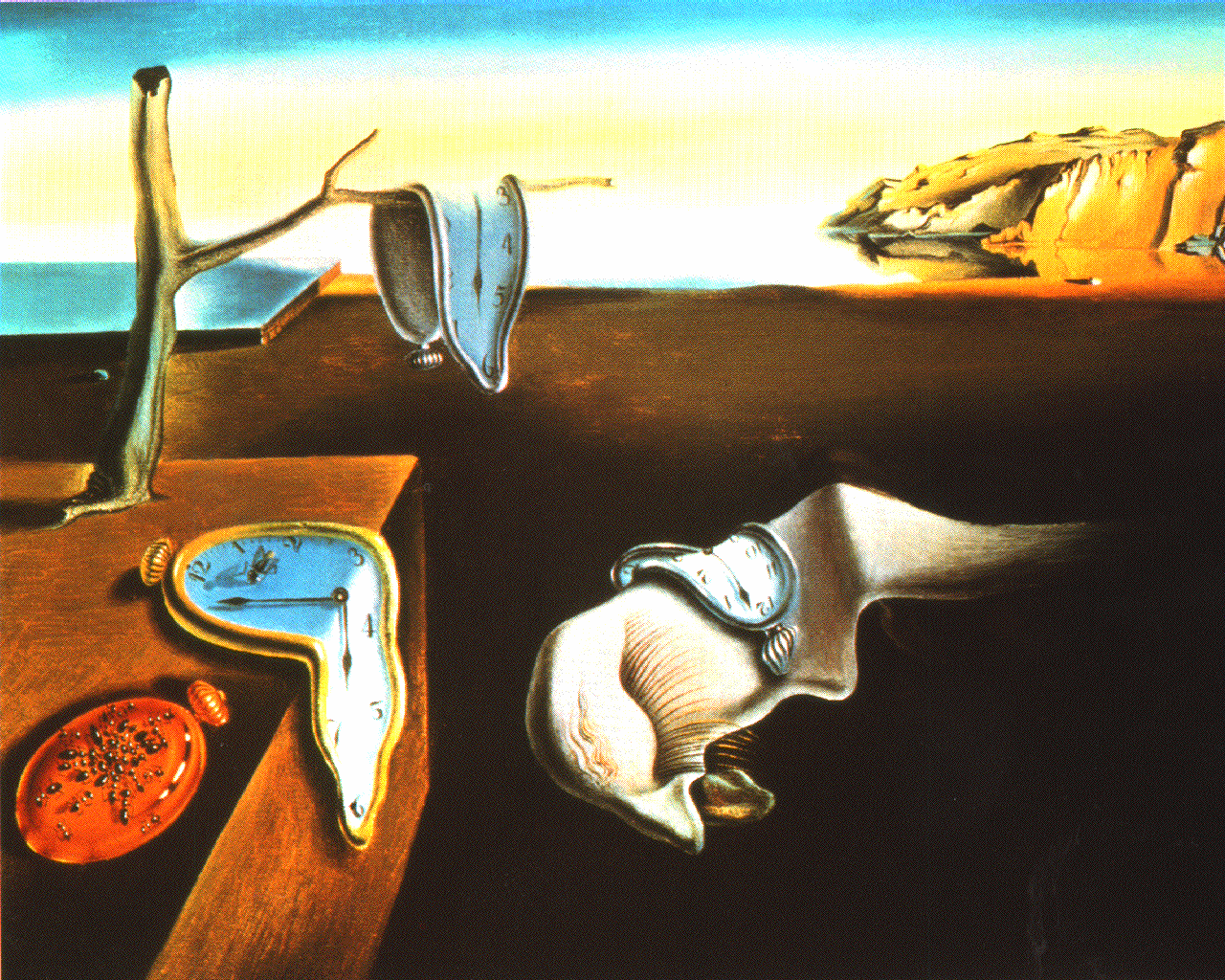
I especially like O'Gorman's idea about painting with Salvador Dali or Max Ernst. I think its important to point out that these artist were not considered part of the art world. Their work was considered crude, childish, and downright offensive. Dali was a surrealist and often painted images from his own dreams. Ernst's work can sometimes appear like a nightmare, with random images fused with the human body. In the tradition of the cyborg, both artist took what they liked from art and put together a new creation. They built their own genre , instead of conforming to the rules.
He discusses William Blake in a later chapter but he touched on the fact that he was one of the first artist to make use of text in artwork. In researching Blake, he did appear mad at times but I think that this idea was in one of his more lucid moments. He wanted to make a bigger impact and reach a broad audience. Despite ridicule, Blake continued on this path and added text to a great many of his paintings.
O'Gorman says quite frequently that the is trying to short circuit the ideas associated with old media. The author supports new ways of conducting humanities research. New media should be able to present ideas in the same rich way that the book used to. Ideas may even become clearer once we make use of hyper links, rich colors, and graphs. The internet is so accessible that it would be a waste if it were not used. I would even like to see it used to its full capacity.

Thursday, March 1, 2007

Education and Structure

The first thing I liked about Nelson was his conversation-like prose. His ideas were presented in a friendly and personable manner. His writing style is actually a good example of his ideas on education. He doesn't condescend, nor does he seem to place any additional barriers between the reader and the text. He emphasizes the need to re evaluate the system that controls education. This portion of the text was the most impressive.

Even the concept of a system of education places a leash on the desire to learn. I don't think that Nelson wants to throw the whole system away,as much as he wants to place the flaws in front of us where they can't be ignored. He makes a point that topics are presented on one angle. Old standards guide what is to be taught, even though technology has made many of these obsolete. This stifles intelligence, not to mention creativity. Learning has become rigid, and much of this is because of our institutions.

Nelson also advocates those willing to educate themselves. Too much attention is placed on the exchange between student and teacher. Some even consider the education that comes from accredited teachers as a sort of "official knowledge", while dismissing the important skills they have learned on their own. I agree with Nelson, that education consistently places a wall between the student and the information and ideas contained in a subject.

CAI seems like an idea that will take away some of the negative aspects of traditional education. A student can afford to get comfortable with the subject matter. There is no teacher racing through material at warp speed. A student's questions will never be ridiculed by CAI. Most importantly the student can breathe, and take in the material as opposed to studying the system. Students usually spend a great deal of time learning what they believe to be "the right answers" rather than the array of concepts and possibilities offered by the material.Education is at its peak when it can provoke thought. It should not be based in tests that have students memorize obscure dates that they will gladly forget in the next hour.